
Dual Eligible Special Needs Plans (D-SNPs) have become the primary vehicle for advancing Medicare-Medicaid integration for beneficiaries who are dually eligible for both programs. Federal policy has increasingly moved D-SNPs toward greater integration, with requirements aimed at strengthening care coordination, aligning enrollment, improving beneficiary protections, and increasing coordination between Medicare Advantage organizations and state Medicaid agencies.
Beginning in 2027, additional CMS requirements will further align D-SNP enrollment with affiliated Medicaid managed care plans. Against this backdrop, recent enrollment data provide an important look at how the D-SNP market is changing and show that the path toward greater integration is influenced by trends in the public and private sectors.
Using CMS Monthly SNP Comprehensive Reports and D-SNP Integration Status files, we examine how the D-SNP market has evolved from 2021 through 2026. We focus on national integration trends, the transition from Financial Alignment Initiative (FAI) demonstrations into D-SNPs, and differences in integration strategies across major parent organizations.
We distinguish among coordination-only (CO) D-SNPs, which coordinate Medicare and Medicaid benefits without meeting higher integration standards; highly integrated D-SNPs (HIDE SNPs), which provide Medicaid behavioral health services and/or long-term services and supports through qualifying Medicaid arrangements; and fully integrated D-SNPs (FIDE SNPs), which integrate a broader set of Medicare and Medicaid benefits under aligned arrangements.
D-SNP Integration Has Increased, but Coordination-Only Plans Remain the Majority
The shift toward greater Medicare-Medicaid integration is visible in the changing composition of D-SNP enrollment (Figure 1). FIDE SNPs reached 11.3% of D-SNP enrollment in 2026, up from the 6%–8% range for most of the 2021–2025 period. Meanwhile, the share of D-SNP enrollment in HIDE SNPs has declined from over 40% in 2021 and 2022 to below 36% in 2026.
Figure 1: Share of D-SNP Enrollment by Integration Status, 2021-2026
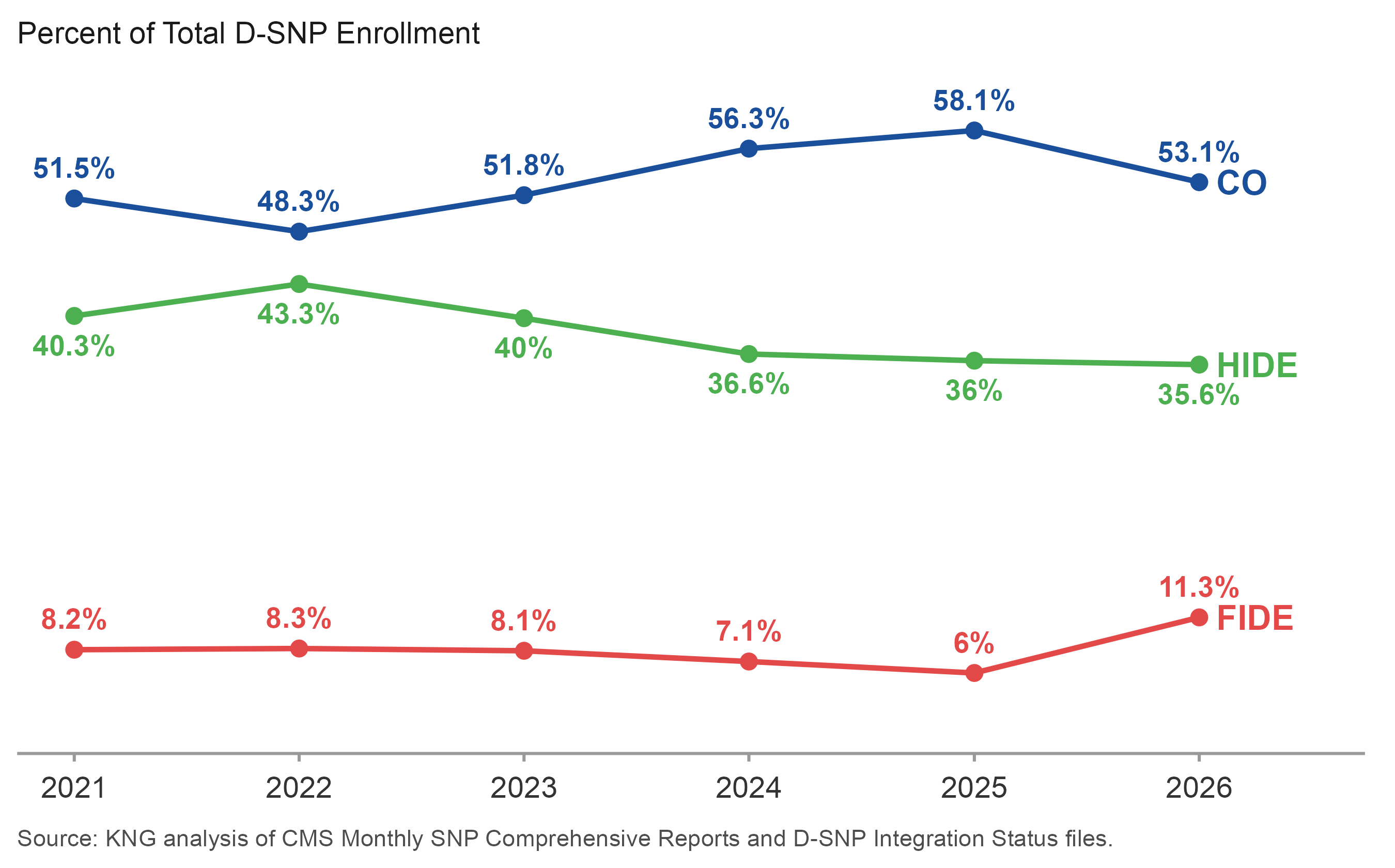
Despite federal efforts to advance integration and growing enrollment in FIDE-SNPs, CO plans continued to account for approximately 53% of D-SNP enrollment in 2026. The national trend, however, masks substantial differences in how states and health plans are approaching integration.
FAI Transitions Reveal Different State Paths to Integration
One of the clearest illustrations comes from the transition away from the FAI, a CMS demonstration program conducted to test alignment mechanisms between the Medicare and Medicaid programs. CMS announced the planned sunset of the FAI Medicare-Medicaid Plan demonstrations in April 2022, giving participating states several years to evaluate and develop their transition paths. In December 2025, seven states—Illinois, Massachusetts, Michigan, Ohio, Rhode Island, South Carolina, and Texas—ended their FAI demonstrations and began transitioning beneficiaries into D-SNPs in January 2026.
Figure 2: D-SNP Enrollment by Integration Status Before and After the FAI Transition
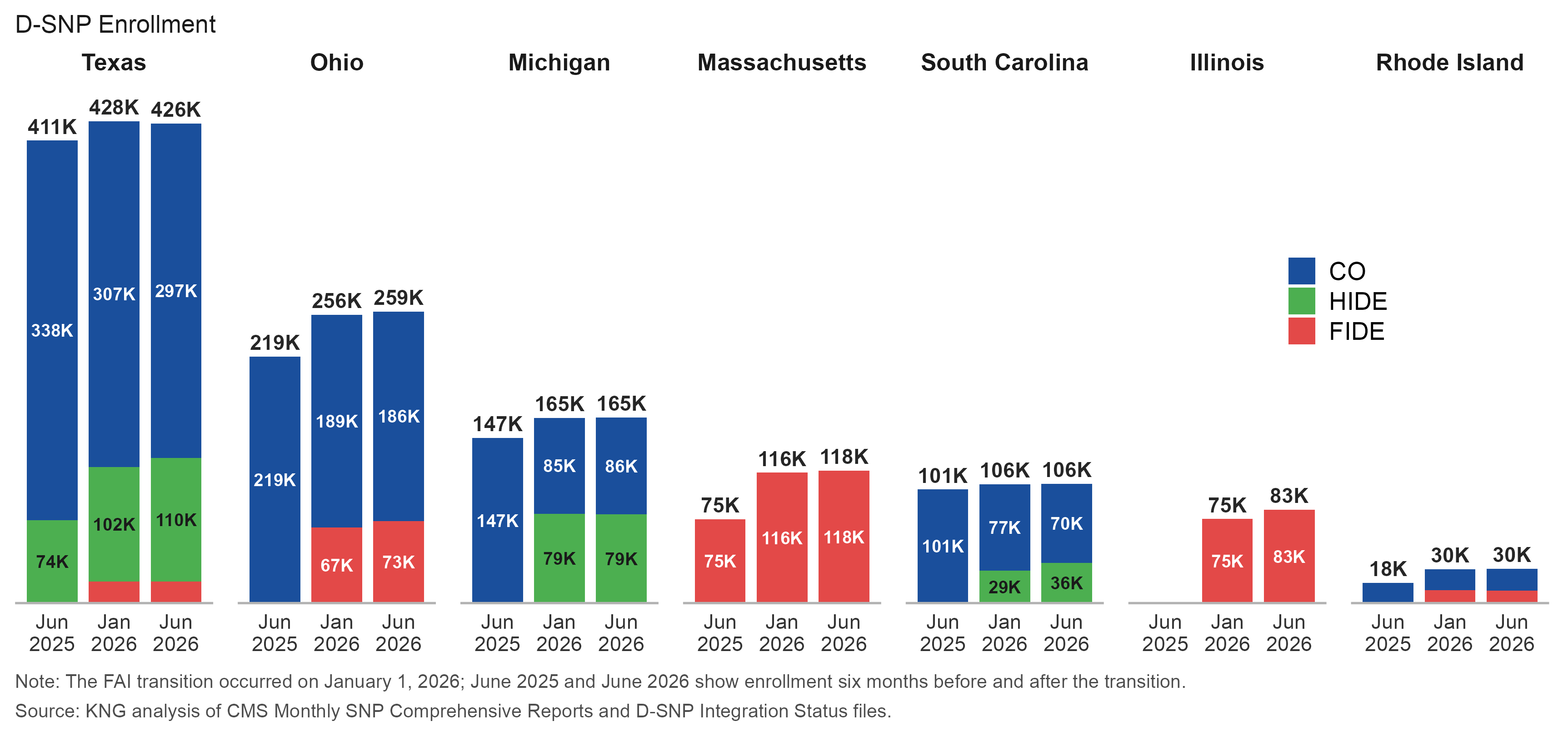
The transitions contributed to substantial changes in D-SNP enrollment (Figure 2). Illinois, which had no D-SNP enrollment as of June 2025, reached 83,017 members in its newly created FIDE-SNP by June 2026. Rhode Island’s D-SNP enrollment increased from 18,109 to 30,490 over the same period, a 68% increase.
But states did not converge on a single integration model. Illinois and Massachusetts moved beneficiaries into new FIDE-SNPs, while Michigan and South Carolina established new HIDE-SNPs. Texas took a mixed approach, retaining a large Coordination-Only enrollment base while expanding HIDE-SNPs and introducing FIDE-SNPs.
Integration Strategies Also Differ Across Parent Organizations
Variation in integration is not limited to states. The D-SNP market is highly concentrated at the parent-organization level. UnitedHealth Group and Humana together account for roughly half of national D-SNP enrollment, at approximately 35% and 15%, respectively (Table 1).
Table 1: D-SNP Enrollment, Plan Footprint, and Integration Mix for the Eight Largest Parent Organizations, July 2026
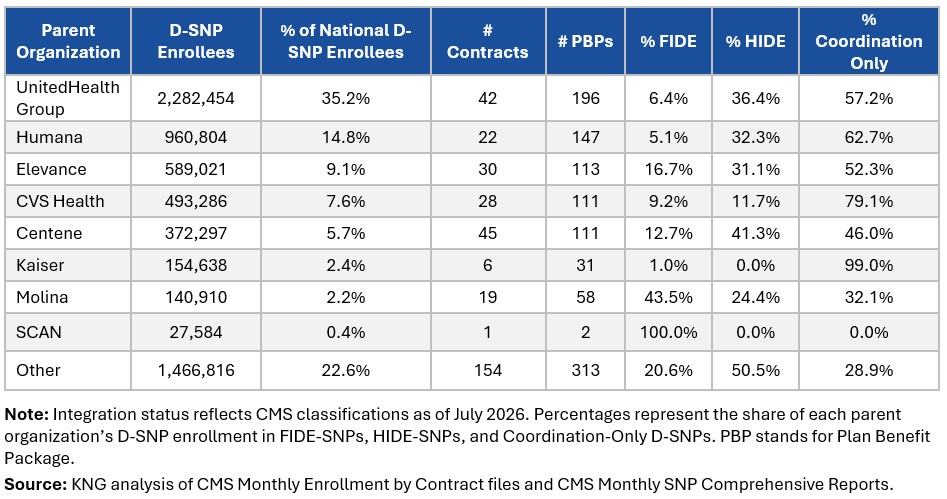
What differs substantially across parent organizations is their mix of integration models. UnitedHealth Group and Humana rely predominantly on Coordination-Only plans, which account for approximately 57% and 63% of their respective D-SNP enrollment. Molina has a substantially different portfolio, with approximately 44% of enrollment in FIDE-SNPs and 24% in HIDE-SNPs. SCAN Health Plan’s D-SNP enrollment, meanwhile, is entirely in FIDE-SNPs. Kaiser’s D-SNP enrollment is overwhelmingly in plans that do not meet the federal HIDE/FIDE criteria for Medicare-Medicaid integration.
These differences matter due to the concentration of the market. UnitedHealth Group and Humana together account for 50% of national enrollment, while the eight organizations listed account for 77.4%. Their integration arrangements therefore shape the coverage experience of a substantial majority of D-SNP beneficiaries. As additional CMS integration requirements take effect, their implications may vary considerably across organizations depending on their existing D-SNP portfolios, the share of enrollment in Coordination-Only arrangements, and state-specific Medicaid contracting requirements and opportunities. For example, organizations with D-SNPs operating alongside affiliated Medicaid managed care plans may need to more closely align Medicare and Medicaid enrollment, consolidate overlapping D-SNP offerings, or modify service areas. These changes could affect organizations differently depending on their Medicaid footprint and existing level of Medicare-Medicaid alignment.
At the same time, current FIDE/HIDE/CO classifications may not fully capture the degree of Medicare-Medicaid alignment already occurring within some organizations. For example, while nearly all of Kaiser Permanente’s D-SNP enrollment is classified as Coordination-Only in our 2026 data, Kaiser is participating in California’s expansion of integrated Medi-Medi Plans, which align D-SNP and Medi-Cal managed care enrollment under affiliated organizations. This highlights the importance of considering both federal D-SNP integration classifications and state-specific integration arrangements when assessing how evolving requirements may affect individual organizations.
Looking Ahead: From Integration on Paper to Integration in Practice
The findings in this blog point to a D-SNP market moving toward greater Medicare-Medicaid integration and highlight different pathways. FIDE-SNP enrollment has reached its highest level since 2021, yet Coordination-Only plans continue to serve the majority of D-SNP beneficiaries. The FAI transitions illustrate how states have pursued different approaches to integration, with some moving beneficiaries into FIDE-SNPs and others into HIDE-SNPs. At the same time, parent organizations maintain substantially different mixes of FIDE-, HIDE-, and Coordination-Only D-SNPs, reflecting variation in their integration strategies. Together, these patterns suggest that progress toward integration is shaped not only by federal requirements but also by state Medicaid policies, market structures, and health plan strategies.
As new CMS policies take effect in 2027, tracking changes in the composition of D-SNP enrollment will provide an important measure of how the market responds. Yet lessons from the FAI suggest that structural integration alone is not sufficient to improve care. While integrated models have demonstrated potential to strengthen care coordination and reduce certain types of institutional care, results have varied across states, and implementation challenges have limited their effectiveness. Greater integration must therefore be accompanied by effective care coordination, continuity of coverage, and meaningful improvements in access to Medicare and Medicaid services. Ultimately, success should be measured not simply by how many beneficiaries enroll in more integrated plans, but by whether these arrangements deliver better care and experiences for the people they serve. Understanding whether different approaches to integration are associated with differences in access to care, care coordination, utilization, outcomes, and beneficiary experience will therefore be an important next step in assessing the evolution of the D-SNP market.
Services : Blog, Payment Policy & Delivery System Innovation, Practice Area - Healthcare Reform and Payment Innovation

|
Dr. Lanlan Xu is a dynamic, results-driven health policy executive with over a decade of experience advancing national healthcare reforms in payment and delivery system innovation, Medicare Advantage, and Medicare & Medicaid alignment. She brings proven expertise in health services research, legislative and regulatory strategy, and cross-sector collaboration, and is a recognized leader in advising senior policymakers on value-based care models and healthcare financing reform. Most recently, Dr. Xu served as Deputy Director of the Division of Health Care Financing Policy (HFP) within the Office of the Assistant Secretary for Planning and Evaluation (ASPE) at the U.S. Department of Health and Human Services. In that role, she led a team of economists and policy analysts focused on Medicare and broader health financing strategies, while overseeing ASPE’s Medicare Advantage portfolio. Previously, at the CMS Innovation Center (CMMI), Dr. Xu led evaluations of large-scale health care delivery models, including the Financial Alignment Initiative for dual eligibles and the Initiative to Reduce Avoidable Hospitalizations among Nursing Facility Residents. Earlier in her career at IMPAQ International (now part of AIR), she led Medicare-focused policy research and evaluations, directed the development of care coordination and quality measures, and supported major CMS models and demonstrations. Dr. Xu holds a Ph.D. in Public Policy from Indiana University and a Ph.D. in German Literature from Georgetown University. |
 Back to Blog