
Medicare Advantage (MA) plans have a financial incentive to steer patients to lower-cost post-acute care (PAC) settings following an inpatient hospital stay. The evidence supports the use of less-intensive PAC in MA as compared to Traditional Medicare (TM). At MedPAC’s April 2026 meeting, MedPAC staff reported that hospitals perceive greater difficulty discharging MA beneficiaries to PAC settings. While the use of lower-cost PAC settings may help improve the efficiency of the Medicare program, inappropriate types of PAC care could have consequences for patients. A 2026 paper in the Journal of American Geriatrics Society, for example, reported that MA enrollment is associated with lower use of inpatient rehabilitation facilities (IRFs) among those hospitalized for hip fracture or stroke, and an increased risk of mortality.
While research has documented greater use of less intensive PAC settings in MA, little attention has been paid to whether MA enrollees are more likely to be discharged home without any PAC after a hospital stay than patients in TM. We evaluate the rates of discharge home without home health (HH) after a hospitalization in MA and TM, as well as distribution of discharges across MA plan types between 2016 and 2023. All rates are MS-DRG- and age-adjusted.
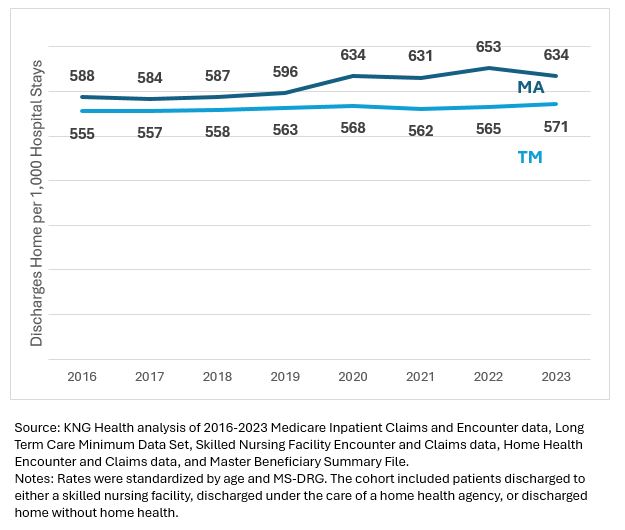
The Difference in Rates of Discharge Home without HH Between MA and TM Grew Following 2019. Between 2016 and 2023, the TM rate was relatively flat with an overall increase of 3% or 16 discharges per 1,000 hospitalizations (Figure 1). In contrast, rates of being discharged home without HH among MA enrollees increased by 8% or 46 discharges per 1,000 hospitalizations. Most of this increase occurred after 2019 (corresponding with the COVID public health emergency, as well as an increase in prior authorization use for PAC by insurance companies and reliance on use of algorithms, AI, and other predictive technologies in prior authorization decisions). By 2023, the MS-DRG-and-age-adjusted rate of being discharged home without HH was 634 per 1,000 hospital stays, compared to 571 for TM beneficiaries. This difference translates to an 11 percent higher likelihood of being discharged home without HH in MA as compared to TM.
Figure 1: Rates of Discharge Home without Home Health per 1,000 Hospital Stays
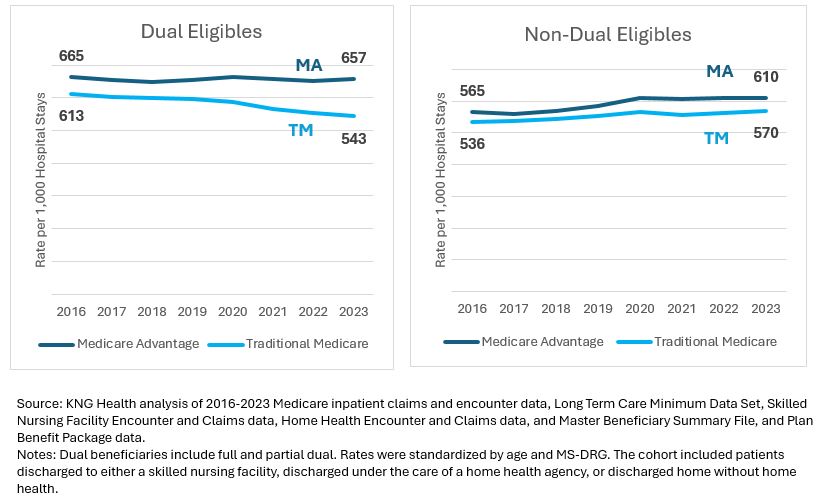
The Rate of Discharge Home without HH has Decreased Among Medicare-Medicaid Enrollees (Dual Eligibles) in TM. While TM consistently has lower rates of discharges home without HH than MA, trends over time vary across Medicare population groups (Figure 2). Among dual-eligible TM beneficiaries, rates of being discharged home have decreased by 11% or 69 discharges per 1,000 hospitalizations between 2016-2023, while the decrease in MA was 1%. In contrast, non-dual beneficiaries are more frequently discharged home in both MA and TM in 2023 relative to 2016 (a 45 and 34 increase per 1,000, respectively).
Figure 2: Rates of Discharges Home without Home Health per 1,000 to Hospital Stays by Medicare-Medicaid Dual Status
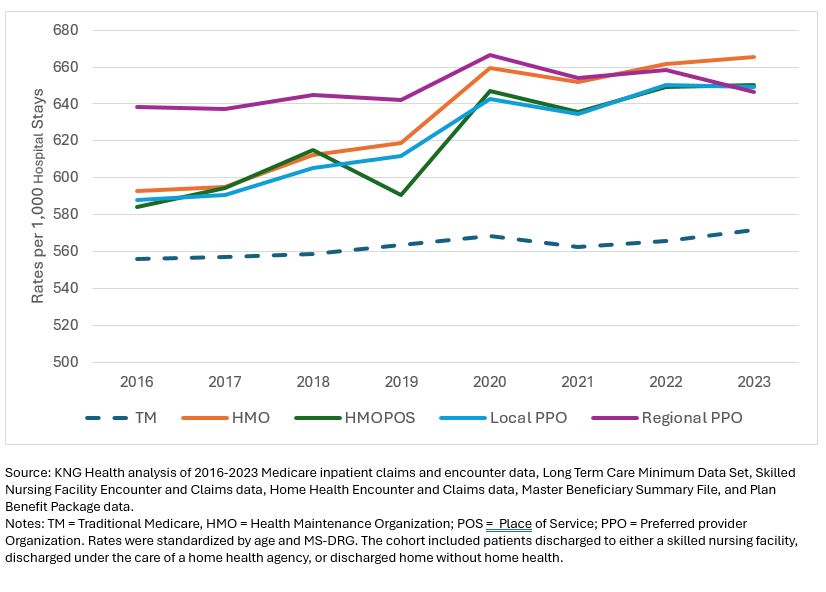
Discharges to home without HH became more common across all MA plan types and across insurers. Regional PPOs had the highest discharge-to-home rate in 2016, but by 2023 they were bypassed by HMOs (Figure 3). While there was a secular positive trend in rates of discharges to home without HH (i.e., utilization rate in TM also slightly increased from 556 in 2016 to 572 in 2023), increases across MA plans were more notable, with discharge home rates across different plan types converging between 645 and 665 per 1,000 discharges in 2023. For comparison, TM utilization of home was at 571 per 1,000 discharges in 2023.
Figure 3: Rates of Discharge Home without Home Health per 1,000 Hospital Stays, by Plan Type
A comparison of discharge rates home across parent organizations shows both the market-wide trend and the heterogeneity across different insurance providers. For the top 20 MA plan parent organizations (Table 1), between 2016-2023 the rate of discharges to home without HH varied across organizations but generally had an increasing trend (with a few exceptions). The highest increase in home discharge rates since 2016 was by Highmark (+63%), which also has the second highest discharge rate to home (788.5 per 1,000 hospital stays). Excellus Health Plan operating as Excellus BlueCross BlueShield, Cambia Health, and Healthfirst also had substantial increases in reliance on discharging home (+33%, +26%, +26%, respectively). Cambia Health had the highest discharge rates to home without HH at 811.5 per 1,000 discharges.
Table 1: Rates of Discharges Home per 1,000 Hospital Stays, by MA Plan Parent Organization
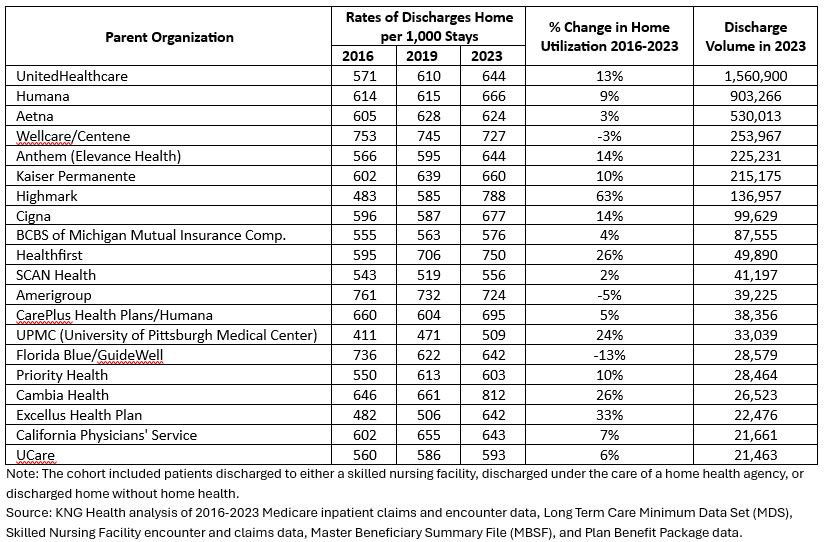
Relative to other parent organizations, Highmark and Excellus Health experienced much larger increases in discharge-to-home rates during the pandemic, which continued increasing thereafter.
Discussion
Between 2019 and 2023, we find an increased rate of hospitalized patients being discharged home without HH among MA enrollees and relatively stable rates for TM beneficiaries. These patterns were influenced by a large reduction in discharges home in TM for dual eligibles and an increase in the discharge rate home among non-dual MA enrollees. Among non-dual eligibles, the increase in the rate of discharge home was similar between TM and MA (8.0% vs. 6.3%). While our comparison of MA and TM rates was adjusted by DRG and age, there might be remaining differences in clinical needs among beneficiaries in MA (e.g., less needs) and TM (e.g., more needs). If this is indeed the case, then the higher rate of discharge home without HH in MA may be appropriate and may save MA plans money by cutting unnecessary home health care. During the study time period, the COVID pandemic also spurred a shift away from PAC (especially institutional settings). This shift appears to have continued into the post-pandemic period.
Our findings by plan type and by parent organization may highlight differences in approaches to management of patient care, application of utilization management tools, and reliance on third-party vendors to coordinate and manage authorization for PAC. HMOs rely on primary care providers (PCPs) as “gatekeepers” to manage care, requiring referrals for specialists’ care and mandatory prior authorization approvals for PAC use. PPOs provide more flexibility with choice of providers but also use prior authorization requirements for PAC use. Increased use of third-party vendors may optimize managed care by getting patients to the “right” setting. However, the financial incentives for these entities may also create a tradeoff between efficiency and care. For example, while getting patients faster to home can reduce hospital-acquired conditions and reduce costs for plans via shorter facility stays, they can also result in discharges home prematurely elevating stress and increasing burden on the patient itself and family members.
The high rates of discharge home without HH among some MA organizations requires further study. Reduced use of HH may push the care burden onto beneficiaries and families, as beneficiaries requiring therapy will need to receive it in an ambulatory setting instead of at home. With this added burden, some patients may forgo needed therapy services because of the additional barriers in accessing care (e.g., cost sharing is higher, transportation availability and associated costs, etc.). A better understanding of how shifts toward discharging post-acute patients home could help build safeguards around access to PAC care for patients who need it.
Services : Blog, Payment Policy & Delivery System Innovation, Quality & Performance Measurement

|
Inna Cintina is a Principal Research Associate in the Evaluation and Health Economics Practice. Dr. Cintina is an applied microeconomist with over a decade of research experience in the area of health economics. At KNG Health, Dr. Cintina is leading evaluations of the impact of managed care on high-need Medicare beneficiaries. Specifically, in work supported by a grant from Arnold Ventures, she is studying the distribution of high-need beneficiaries across enrollment types (Traditional Medicare, Accountable Care Organization (ACOs); and Medicare Advantage (MA)), healthcare services utilization and health outcomes in high-need beneficiaries attributed to ACOs relative to those in MA; and characteristics of MA plans associated with better health outcomes among enrollees. In other work, she studied disparities in utilization of new cardio- and neuro-vascular technologies and impacts of post-acute care settings on beneficiary outcomes. She is an expert in using matching techniques, difference-in-difference methodologies, and other quasi-experimental statistical approaches, as well as producing client-oriented materials, white papers, and manuscripts. She has authored/co-authored more than a dozen articles, which have been published in peer-reviewed journals such as World Bank Economic Review, Health Economics, JAMA, Value in Health, and the American Journal of Managed Care. Prior to joining KNG Health, Dr. Cintina worked at the Lewin Group/OptumServe and the University of Hawaii at Manoa. She has extensive experience in developing and implementing methodologies for identification of causal relationships, advanced analytics, project management, economic burden/cost of illness studies, and impact evaluations of alternative payment models, such as CMMI’s Bundled Payments for Care Improvement Initiative and Oncology Care Model. Dr. Cintina has a PhD in economics from Clemson University, a MSC in European Economics and Public Affairs from University College Dublin, and an MA and a BA in economics from the University of Latvia. |

|
Katie Fujimori is a Research Assistant in the Evaluation and Health Economics practice at KNG Health. Their work includes assisting with quantitative analyses as well as conducting literature reviews on topics such as value-based payment programs and financial indicators associated with hospital closures. Prior to joining KNG Health, Fujimori taught Geometry and Algebra at UIC College Prep in Chicago. They have a Bachelor of Arts in Economics from Connecticut College. |

|
Lane Koenig is President and Founder of KNG Health Consulting and Director of the Healthcare Reform and Payment Innovation Practice. He is a healthcare economist with over 20 years’ experience in the public and private sectors. As President of KNG Health Consulting, Dr. Koenig has overall responsibility for the quality and direction of KNG Health’s research. He serves as Project Director and Principal Investigator for many studies, particularly those related to healthcare reform proposals, healthcare provider payments, value-based purchasing, and delivery system innovations. With expertise on hospital and post-acute care payment and quality issues, his work regularly assesses the potential impact on hospitals and other providers of proposed legislation or regulations. He has assisted both industry and Federal and state governments in the development and assessment of healthcare provider payment policies and value-base purchasing initiatives. Prior to founding KNG Health in 2007, Dr. Koenig was the senior economist in the Office of Policy at the Centers for Medicare & Medicaid Services (CMS). Before joining CMS, Dr. Koenig was a Senior Scientist in the healthcare finance practice at The Lewin Group. Dr. Koenig has led over 100 quantitative and qualitative health policy and health economic studies and has published over 20 peer-reviewed studies in journals, such as Health Affairs, Health Services Research, and Medical Care. He graduated with Honors from the University of Florida, Gainesville and earned his PhD in Economics from the University of Maryland, College Park. |
 Back to Blog